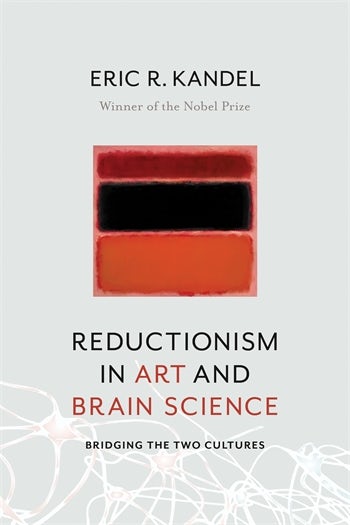
Reductionism in Art and Brain Science Bridging the Two Cultures Eric Kandel
Pub Date: June 2018
ISBN: 9780231179638
240 Pages
Format: Paperback
List Cost: $22.95 £17.99
Pub Date: Baronial 2016
ISBN: 9780231179621
240 Pages
Format: Hardcover
List Price: $29.95 £25.00
Pub Date: Baronial 2016
ISBN: 9780231542081
240 Pages
Format: E-book
Listing Toll: $21.99 £16.99
Are art and science separated by an unbridgeable divide? Tin they observe common footing? In this new book, neuroscientist Eric R. Kandel, whose remarkable scientific career and deep interest in art give him a unique perspective, demonstrates how scientific discipline can inform the manner we feel a work of fine art and seek to empathise its pregnant. Kandel illustrates how reductionism—the distillation of larger scientific or aesthetic concepts into smaller, more tractable components—has been used past scientists and artists alike to pursue their respective truths. He draws on his Nobel Prize-winning work revealing the neurobiological underpinnings of learning and memory in sea slugs to shed light on the complex workings of the mental processes of higher animals.
In Reductionism in Fine art and Brain Science, Kandel shows how this radically reductionist arroyo, applied to the most complex puzzle of our time—the brain—has been employed past modernistic artists who distill their subjective world into color, form, and lite. Kandel demonstrates through lesser-upward sensory and top-down cognitive functions how science tin can explore the complexities of man perception and help usa to perceive, appreciate, and sympathize great works of fine art. At the eye of the book is an elegant elucidation of the contribution of reductionism to the evolution of modern art and its role in a awe-inspiring shift in artistic perspective. Reductionism steered the transition from figurative art to the first explorations of abstract art reflected in the works of Turner, Monet, Kandinsky, Schoenberg, and Mondrian. Kandel explains how, in the postwar era, Pollock, de Kooning, Rothko, Louis, Turrell, and Flavin used a reductionist approach to get in at their abstract expressionism and how Katz, Warhol, Close, and Sandback built upon the advances of the New York Schoolhouse to reimagine figurative and minimal art. Featuring captivating drawings of the encephalon alongside full-color reproductions of modern art masterpieces, this volume draws out the common concerns of science and fine art and how they illuminate each other.
Eric R. Kandel seamlessly moves between the intricacies of scientific discipline and art, weaving their histories into a mutual narrative that illuminates both fields and shows they have more in common than is often assumed. It is a fun and informative read that anyone with a curious mind can savour and larn from. Joseph LeDoux, author of Broken-hearted: Using the Brain to Empathise and Treat Fear and Anxiety
Kandel'southward volume, with 1 foot in the humanities and ane foot in the sciences, stands comfortably in both. Writing in deceptively simple prose, not unlike the art he writes about, Kandel lucidly states the biological instance for how abstract art challenges u.s.a. to await so that we can see. Jim Coddington, chief conservator, Museum of Mod Art
Words similar 'genius' or 'renaissance human being' are rarely used in these egalitarian times, but such descriptions wouldn't be entirely inappropriate for Kandel, who is renowned for his work on retentiveness. He has now written a remarkable book full of poetic insights without compromising scientific rigor. V. S. Ramachandran, author of The Tell-Tale Brain: A Neuroscientist's Quest for What Makes U.s. Human
Aiming to lessen the gap between the cultures of art and science, Kandel forwards new ways of considering abstract fine art through the model of reductionism: less is more when it comes to stimulating the brain's artistic abilities and our aesthetic responses. Emily Braun, Distinguished Professor of Art History, Hunter College and the Graduate Center, CUNY
In this engaging and brilliant exploration, Kandel illuminates the beauty and power of both abstruse art and the encephalon and mind that unravels information technology. It is a assuming and exciting story near the modern revolution in art and brain scientific discipline that bridges the traditional chasm between the culture of the arts and sciences and helps us sympathize and experience the most challenging art with the depth it deserves and the joy it enables. Walter Mischel, author of The Marshmallow Test
Eric Kandel's new book, Reductionism in Art and Encephalon Science is a beautiful integration of visual art and neuroscience. The volume engages C.P. Snow's theme of two cultures- the humanities and the sciences- and provides an aesthetic window into the science of the mind through his fourteen nicely written capacity that include elegant figures in visual art and neuroscience. While the volume de-mythologizes the idea of reductionism, it too chiefly provides a sense for knowing an object and the objects to be known. This is a must read for both neuroscientists and anyone interested in the visual arts and humanities. Jay Schulkin, Georgetown University
[A] fascinating survey of mind science and modern art.... Kandel presents concepts to ponder that may open new avenues of art making and neuroscientific endeavor. Publishers Weekly
[An] intriguing treatise. Nature
Recommended for those interested in the intersection of psychology and art. Library Periodical
The effort to complete this book volition be well rewarded.... C.P. Snow would exist proud. Neurology Today
Unique and thought-provoking. Times Higher Education
Elegant and entertaining. Wall Street Journal
[Eric Kandel's] new book offers one of the freshest insights into art history in many years. Salon
A pleasure to read FASEB Periodical
The result is an intriguing, thought provoking book which will appeal to those with pre-existing noesis just also to those who may be unfamiliar but curious. Megan Kenny, University of Huddersfield, The British Social club for Literature and Science
Kandel makes an of import contribution with this volume; he lucidly describes the very active interplay across disciplines that has taken place with regard to exploring how data is managed and understood, and and so related beyond artistic mediums, scientific research, and socially, through sharing of ideas and findings. PsycCritiques
Kandel's theory of how are our neurons burn down in response to abstract art is illuminating. . . . I looks forrard to hearing more from Kandel, a most inventive scholar, now that his bridge has been solidly congenital. The New Criterion
Role I: 2 Cultures Meet in the New York Schoolhouse
Introduction
ane. The Emergence of an Abstruse School of Art in New York
Office Two: A Reductionist Arroyo to Encephalon Science
two. The Start of a Scientific Approach to the Perception of Art
3. The Biological science of the Beholder's Share: Visual Perception and Bottom-Up Processing in Fine art
4. The Biology of Learning and Retentiveness: Top-Down Processing in Art
Part III: A Reductionist Approach to Art
five. Reductionism in the Emergence of Abstract Art
vi. Mondrian and the Radical Reduction of the Figurative Image
7. The New York School of Painters
8. How the Brain Processes and Perceives Abstract Images
9. From Figuration to Color Abstraction
10. Color and the Brain
11. A Focus on Light
12. A Reductionist Influence on Figuration
Part 4: The Emerging Dialogue Betwixt Abstruse Art and Science
13. Why Is Reductionism Successful in Art?
fourteen. A Return to the Two Cultures
Acknowledgments
Notes
References
Analogy Credits
Index
- Read an interview with Eric Kandel in The Wall Street Journal
- Listen to an interview with Eric Kandel on Science Fri
- Eric Kandel discusses the book on The Big Think
Commended, 2017 PROSE Laurels in Biomedicine and Neuroscience
palaciosfrand1961.blogspot.com
Source: http://cup.columbia.edu/book/reductionism-in-art-and-brain-science/9780231179621
0 Response to "Reductionism in Art and Brain Science Bridging the Two Cultures Eric Kandel"
Post a Comment